
Where can projects get "lean"?
Rainer Erne 19.02.2020
In the current discussion about "classical", "agile" and "hybrid" approaches in project management it is too often overlooked that projects and project management have the potential in any approach to get "leaner". Directed by the ideas of "Lean Management" five spots can be identified:
- Prevent the start of unnecessary, half-hearted and under-resourced projects
- Dismantle excessive standardisation, professionalisation and job creation in organisational project management
- Simplify organisational structures between project and line management on the one hand and within the project organisation on the other hand
- Limit strictly work in progress in projects
- Establish a straightforward management of mistakes in projects
Ad 1. Prevent the start of unnecessary, half-hearted and under-resourced projects
According to an older study of Manfred Gröger (2004) the most important action point to get prject management 'lean' is to prevent the start of projects at all. This proposition is corroborated by a survey with 962 managers in German companies and administrations. Accoridng to this survey, the respondents assess the manjority of the project in their organisations as "ineffective". The reasons are inadequate resources ("drought projects"), the addressing of unpopular topics ("alibi projects"), the intention to link a topic with the organisation for reputation reasons ("prestige projects") or projects which are initiated below the organisational radar system ("submarine projects"). If said projects follow a "classical", an "agile" or a "hybrid" approach is simply irrelevant. The more important question is: How can an organisation significantly reduce the number of unnecessary and ineffective projects?
Ad 2: Dismantle excessive standardisation, professionalisation and job creation in organisational project management
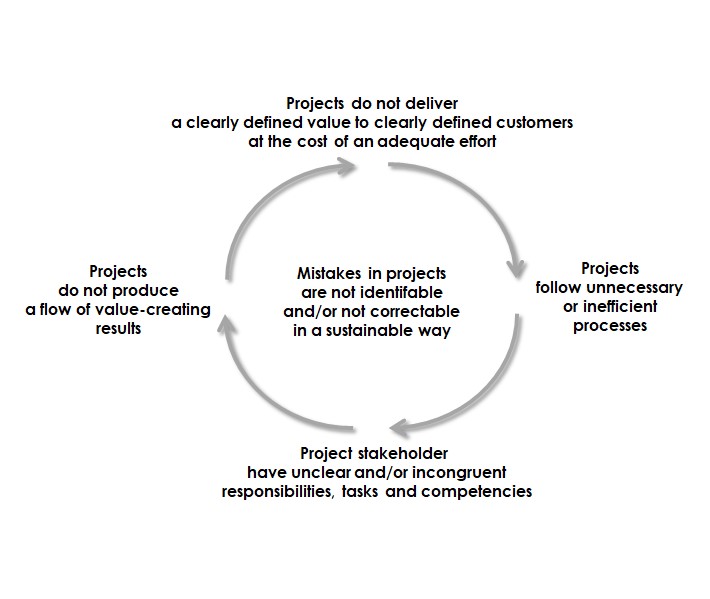
Professionalisation of Project Management has increased during the last 30 years: Meanwhile there are three international project management standards (IPMA, PMI and PRINCE2) with respective certifications, career paths and PMO's. Nonwithstanding the effeciveness of said professionalisation streams, the other side of the medal should not to be overlooked: standardisation enhances professionalisation, i.e. certifications and career paths which, in turn, initiates the creation of new project management jobs. This circle ends in some cases in an esoteric specialism and excessive management activities which favors the cxreation and justification of project management jobs over the effective and efficient delivery of project results. The important question in this respect is: How can management activities in projects be "purified" and refocussed to value-creating activities?
Ad 3: Simplify organisational structures between project and line management on the one hand and within the project organisation on the other hand
The Project Management Profession discusses often about the "right project organisation". This discussion revolves around terms like "staff organiation", "matrix organisation" or "project oriented organisation". In these discussions, real organisation issues in project management are often neglected: the establishment of clear responsibilities, tasks and comptencies between project and line management on the one hand side and within the project on the other hand side. If this would be strictly implemented, a great deal of conflicts between "sponsors" and "project managers" as well as "project managers" and "work package responsibles" would simply dissolve. The most important question with regrad to project organisation is, therefore: how could a minimum of roles be defined and these roles be equipped with clear and congruent responsibilities, tasks and competencies without major overlaps.
Ad 4: Limit strictly work in progress in projects
One of the root causes for schedule and budget overruns in projects are the number of ongoing tasks. This phenomenon is also labelled "multitasking" and "task switching". "Lean Projects" demand a strict limitation of work in progress. This could be achieved by bottleneck-oriented prioritisation, as proposed by "Crictical Chain Project Management", by "WIP-limits as suggested by the "Kanban" approach, or "Time Boxing" which is applied in "Scrum". More important than the approach is the question: How can "work in progess" be effectively limited in order to yield a coninous flow of results?
Ad 5: Establish a straightforward management of mistakes in projects
The effectiveness of "lessons learned" and other quality assurance measures in projects is discussed in recent times. Said measures are usually "executed as ordered" without delivering any significant benefit for the customer or for preventing mistakes in other projects.
In order to institutionalise an effective quality management in projects it has to be clear what a "mistake" (and what a "feature") actually is. Dependend on this definition mistakes could be identified which have to be "cleared" and mistakes which have to be solved. Hence the important question in this respect is: How can we identify mistakes in projects clearly and how can we manage them in a way to improve the value of the project?
Approaches to answer abovementioned questions
Approaches to answer abovementioned questions are to be found in Erne (2019)
Literature:
Gröger, M. (2004) Projektmanagement: Abenteuer Wertvernichtung. Eine Wirtschaftlichkeitsstudie zum Projektmanagement in deutschen Organisationen. München, MBA