What can be achieved by defined processes?
There is a widespread misconception, particularly in organisations with a strong focus on formal procedures: defined or optimised processes are not a panacea for every ‘ailment’ within the organisation (lack of strategic direction, lack of clearly defined roles, lack of performance feedback, etc.).
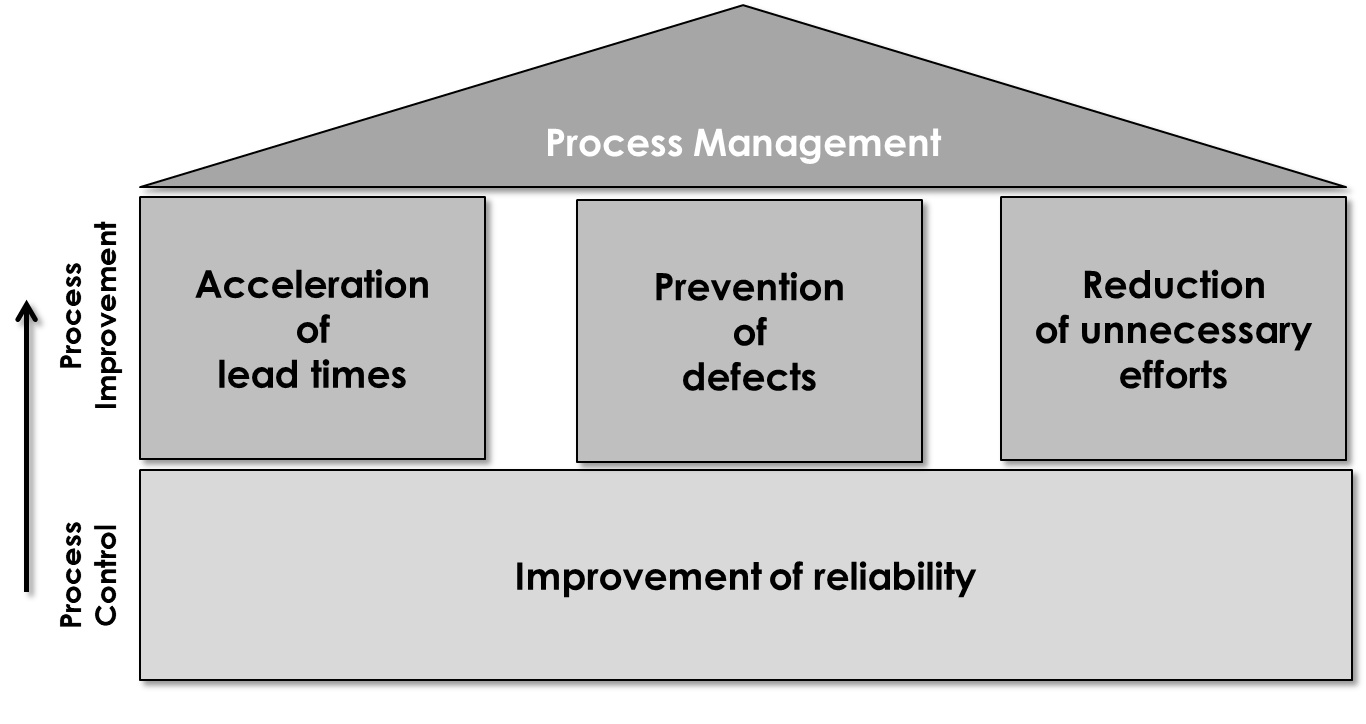
Rather, defined processes are a tool for achieving four objectives:
- Reliability: Adherence to plans in commitments regarding services, deadlines and/or costs
- Speed: Short lead times from enquiry to delivery
- Efficiency: Minimal effort from enquiry to delivery
- Zero defects: zero defects in value creation processes
Said four performance potentials are not simply unrelated elements existing side by side; rather, they set out a direction for process management: first, reliability must be consistently achieved in the performance promises. Only then are processes ‘under control’. It is only on this basis that ‘process optimisation’ – in terms of lead times, effort and errors – becomes possible.
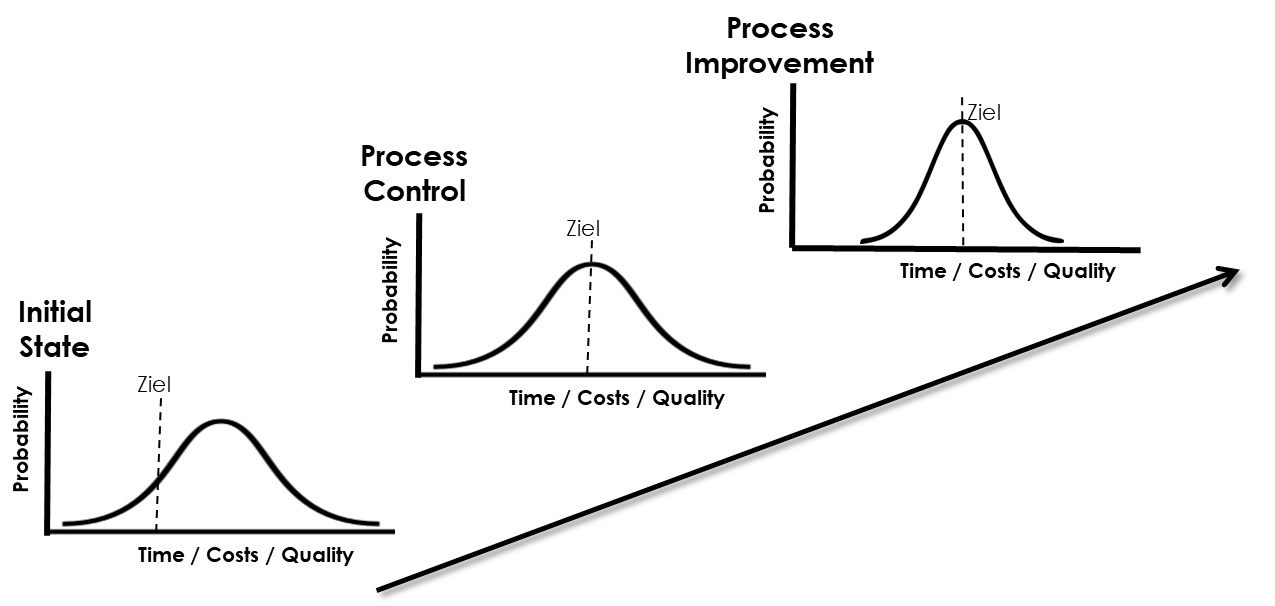
This is also the fundamental principle underlying all process maturity models, from CMMI to the OMG’s Business Process Maturity Model (BPMM): the first step is to reliably meet commitments regarding deadlines, costs and quality, for which the targets must not be set too ambitiously (‘process mastery’). It is only at subsequent maturity levels that the target range for these three parameters is set at a more demanding level (‘process improvement’).
‘Focused process management’ means, firstly, using defined processes to achieve one or two of these objectives – and not as a ‘panacea for the organisation’. Secondly, it is about not only realising the performance potential of processes, but also avoiding the risks associated with incorrect or poor process management.
What risks do defined processes imply?
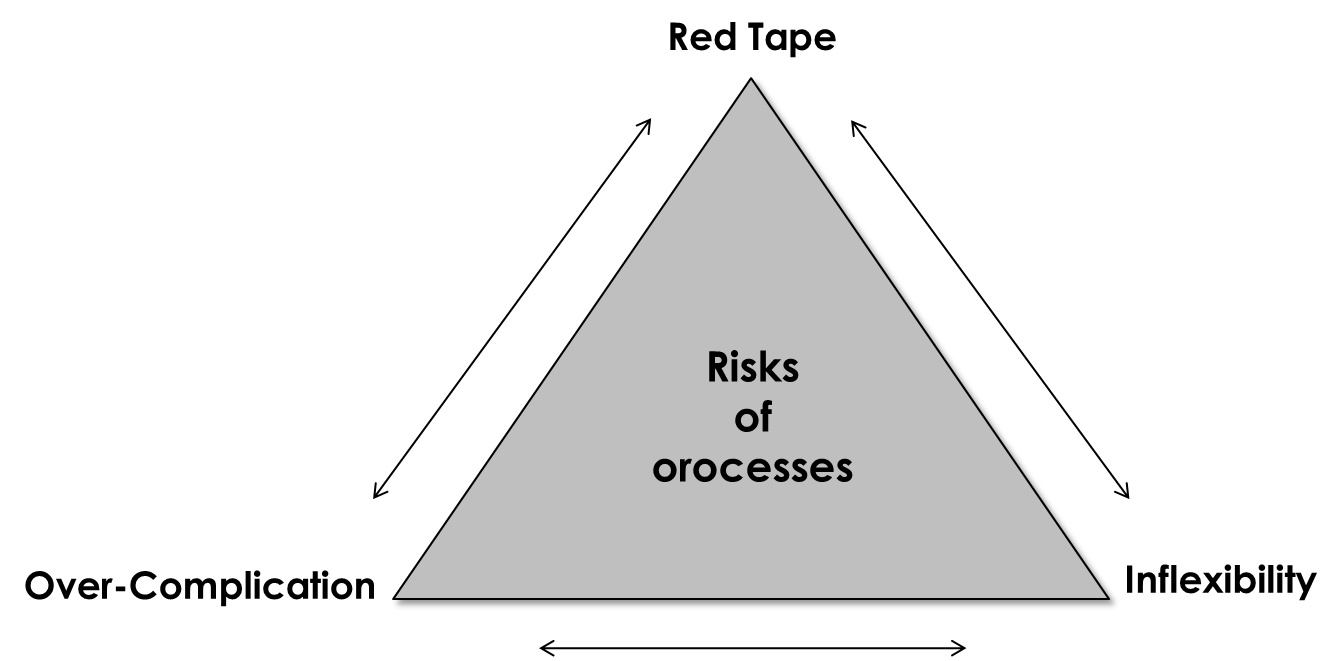
Incorrect and poor process management is evident from three symptoms:
- Red Tape: Defined processes can significantly increase the burden of documentation, reporting requirements, lead times and the time spent searching for information, without any significant benefit.
- Over-complication: Defined processes can become an esoteric subject reserved for specialists. Complicated process modelling and process-oriented IT systems are neither understood nor accepted by those carrying them out, which in turn significantly hinders the effectiveness of the processes.
- Lack of flexibility: Defined processes can restrict short- and long-term scope for action to such an extent that it becomes virtually impossible to respond as required to changes and special requests.
In a nutshell: Well-defined processes can sometimes have the opposite effect to what they were intended to achieve. That is why focused process management is required.
How can focused goals be achieved by processes?
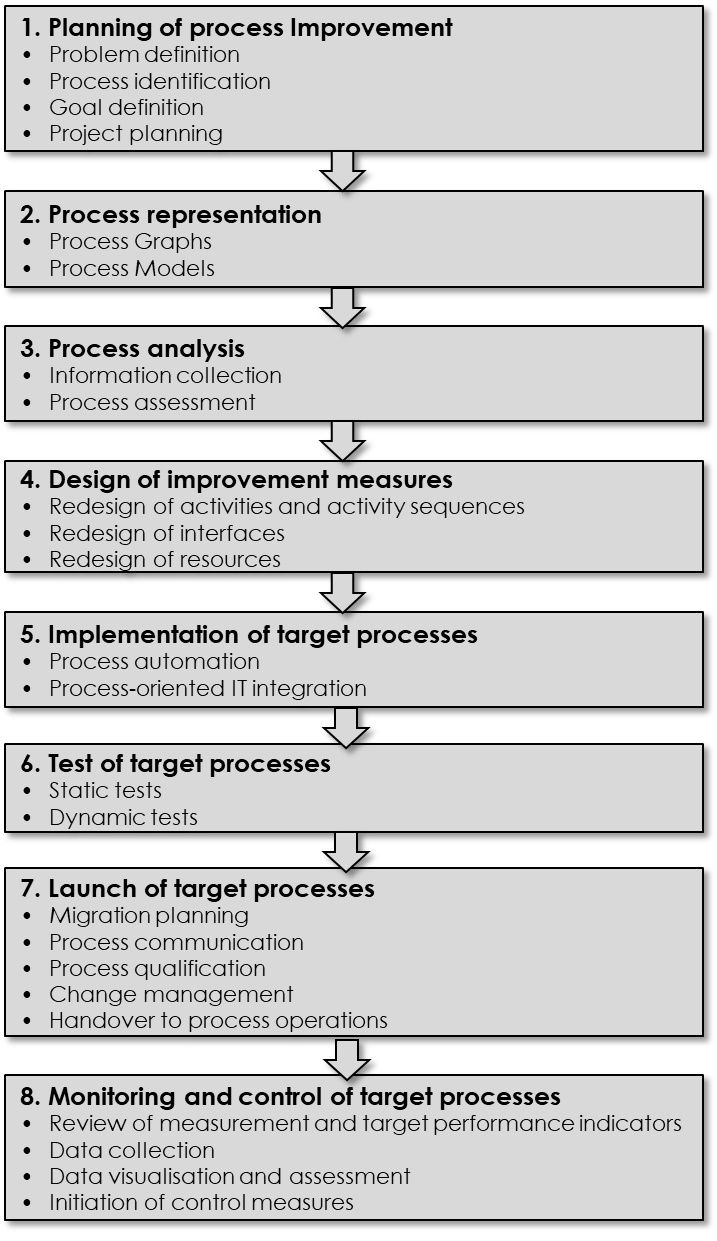
Reliability, speed, effort reduction and zero defects can be achieved by deliberate measures taken at specific stages of the process improvement:
- Planning of process improvement: Firstly, it is crucial that the organisational problem areas addressed are those that can actually be tackled using the ‘process management’ tool. Secondly, process objectives should be defined in a way that is clear, measurable and balanced. Thirdly, when planning the project, care must be taken to ensure, firstly, that full capacity is available in defined time slots and, secondly, that change management activities form an integral part of the planning.
- Process analysis: Particularly when it comes to gathering information and assessing processes, the objectives defined at the outset serve as a guide to ensure that neither too much nor too little information is gathered and analysed.
- Implementation of target processes: ‘Usability’ is the key concept that enables processes to be integrated, as it were, automatically into the working context of those involved.
- Testing of target processes: Depending on the development phase, a distinction can be made here – as in software development – between static tests ‘on paper’ and dynamic tests ‘in action’.
- Monitoring and control of target processes: the acceptance, implementation and effectiveness of the processes in relation to the objectives are the key control indicators and measures.
Further reading
Association of Business Process Management Professionals (ABPMP) ed. (2019) BPM CBOK Version 4.0: Guide to the Business Process Management Common Body Of Knowledge. Version 4.0. 4th ed. North Charleston, CreateSpace.
Erne, R. (2026) Prozessmanagement klipp & klar. Springer Gabler, Wiesbaden.
Fischermanns, G. (2013) Praxishandbuch Prozessmanagement: Das Standardwerk auf Basis des BPM Framework ibo-Prozessfenster.
11. Aufl. Gießen, Götz Schmidt.
Gadatsch. A. (2023) Grundkurs Geschäftsprozess-Management. Analyse, Modellierung, Optimierung und Controlling von Prozessen. 10. Aufl. Wiesbaden, Springer Vieweg,
Schmelzer, H.J. & Sesselmann, W. (2020) Geschäftsprozessmanagement in der Praxis: Kunden zufriedenstellen, Produktivität steigern, Wert erhöhen. 9. Aufl., München, Hanser.
Stöger, R. (2025) Prozessmanagement: Qualität, Produktivität, Konkurrenzfähigkeit. 5. Aufl. Stuttgart, Schäffer-Poeschel.