
Five misconceptions about efficiency in organisations
Rainer Erne 02.04.2020
For the sake of increasing efficiency in organisations managers frequently and automatically take up "instant buzzwords" such as "agility" or "digitisation". Said behaviour reveals common misconceptions about the term "efficiency". In order to make efficiency measures effective, said misconceptions have to be clarified first.
"Hot topics" in organisations are following industry-wide trade cycles. This is also applicable to the topic "efficiency" which is being promoted to a "hot topic" in times of low interest rates, structural shifts, tightening of mandatory spending caps or loss of attractiveness of established business models.
For abovementioned reasons it is worth to clarify five misconceptions of the notion of efficiency in organisations which appear repeatedly in all industries. Said "land consolidation" aims at supporting a more serious and sustainable handling of the topic.
The five misconceptions are the following:
- "It is evident where efficiency potentials are to be found in our business"
- "The silver bullets of organisational efficiency are automation and digitisation"
- "Increases of efficiency are feasible without touching established command and control structures"
- "Agility is always more efficient than linear approaches"
- "Efficiency enhancement is attainable by a project"
Misconception 1: "It is evident where efficiency potentials are to be found in our business"
A first misconception consists in the fact that the identification of organisational efficiency potentials is dependent on the right method (or consulting firm). For, if Research & Development or Sales & Service staff locate unambigous sources of waste in excessive documentation or review requirements, the same is viewed from the perspective of Quality or Compliance employees as a "must" for securing quality and transparency.
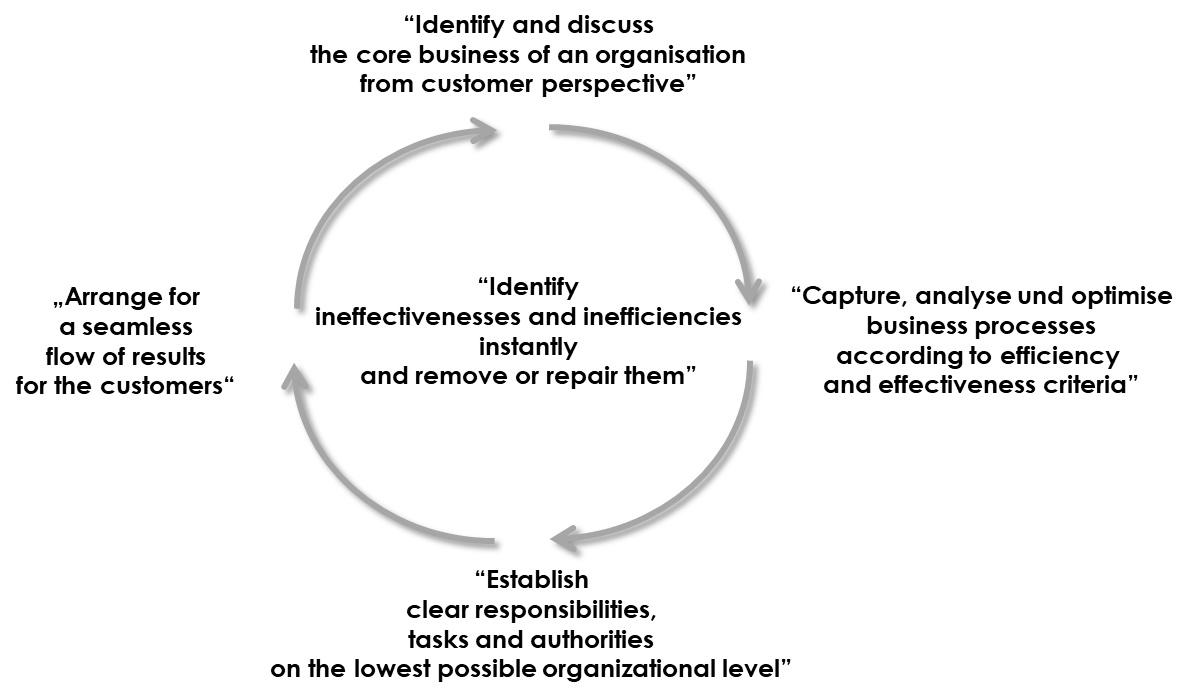
The only way out of this discussion is a commonly accepted and mandatory point of reference on what the core business of an oranisation is (and what explicitly not) and on who the customer is, for whom results are produced.
Only this common basis allows for the clear designation of activities outside of the core business as well as outside of customer focus. Said activities may then be classified as "waste type I" or "waste type II", as suggested by Lean Management. The first type of waste calls for economisation, the second one for elimination. Activities which form the core business, on the other hand, have to be designed according to effectiveness criteria.
Misconception 2: "The silver bullets of organisational efficiency are automation and digitisation"
As soon as organisational efficiency potentials are known, a second mistake is to look for "instant solutions". This term denotes ready-made and comprehensable management concepts and tools which are summarised (and budgeted) as "automation" and "digitisation".
Frequent experiences demonstrate that automation and digitisation pose very often new problems since data are frequently written back and forth from Excel to the ERP system, access authorisations and/or skills are missing. The question, how the gains of a "digital transformation" project can be quantified or at least estimated, is often not answered at all or in a very foggy way.
Automation and digitisation which delivers results that make a difference requires the collection, analysis and optimisation of business processes. Without this precondition digital "solutions" remain ineffectively at best, in the worst case they manifest a "disimprovement" of the current state. In both cases the solution would be an additional source of waste.
Misconception 3: "Increases of efficiency are feasible without touching established command and control structures"
The focus on conceptual and/or technological "instant solutions" for improving organisational efficiency yields the opportunity for managers to ignore political sources of waste.
Above mentioned sources of waste include, for example, the fact that the importance of positions in organisations is frequently derived from the number of directly subordinated staff. Subsequently, experienced managers utilise economic boom phases for a largely uncontrolled growth in job numbers in order to consolidate their own position. In German labour contexts are these jobs, once created, hardly abolishable. Moreover, these jobs, once created, have to be filled out with work or, alternatively, create new work, not infrequently in peripheral areas of the core business of an organisation. The further existence and continuity of these peripheral jobs are then, in subsequent phases of economic slowdowns, protected and defended against all claims for enhancing efficiency. Organisational structures and processes are henced designed around questionable jobs with braking effects on any efficiency program.
Organisational efficiency demands a clear designation and disclosure of unnecessary jobs in organisations as well as the establishment of clear resposnibilities, tasks and authorities with a view to value-adding tasks. The outcome of this process does not have to be job downsizing, yet rather job redesign as well as a strict diet with respect to the appetite for creating new jobs.
Misconception 4: "Agility is always more efficient than linear approaches"
One of abovementioned "instant solutions" include the new term "agility" which is often simply equated with "method for efficiency improvement".
Derived from experiences in software development, where agile approaches like "Scrum" or "Software Kanban" are practiced since years, it is commonly accepted that agile approaches deploy their potential mainly for projects with fuzzy results and high levels of innovation. Waste is hereby reduced by skipping unnecessary planning and re-planning, generating fast and testable results, contious integration of users and accelerated feedback and learning loops. However, from said industry it is also known that agile approaches have their llimitations. This is the case, when a "big picture" of a product, service or solution with a medium to high level of complexity is required. Limtations get also visible in all phases after concept freeze, when the main tasks consist in commercialisation and industrialisation of solutions. In said situations, linear waterfall approaches which are well-known from classical project and process management, display their potentials.
Hence, when one starts an efficiency program in an organisation, it should be clearly classified and clarified which tasks should be completed in agile and which in linear approaches.
Misconception 5: "Efficiency enhancement is attainable by a project"
The last misunderstanding relates to the procedure for efficiency incresing. Generally such an endeavor is organised as a project or program (which encompasses numerous projects in a coordinated way).
Project organisation is suitable for initiatives exhibiting a certain degree of novelty as well as a clear start and closing date. Though especially the last mentioned characteristic leads to the collective behaviour that, as soon as a streamlining project has finished, a sigh of relief permeates an organisation since business as usual can be continued, which means: uncontrolled creation of jobs, uncoordinated automation initiatives etc.
Efficiency is - besides effectiveness - a core and continous task as well as a key performance indicator for correct and proficient management. From this point of view, project organisation does not seem to be very suitable to keep an organisation in an efficient shape. Rather efficiency has to be a daily design and evaluation criterion in meetings, goal agreements, performance appraisals and improvement initatives. Otherwise, a lifelong process of repeated efficiency improvement programs will never come to an end.
Literature:
Erne, R. (2020) Referenzpunkt Kerngeschäft. FAZ Managementkompass: Operative Effizienz, 01/2020, S.10-14.