
Decelerate the vicious circle of continous change projects
Rainer Erne 12.01.2020
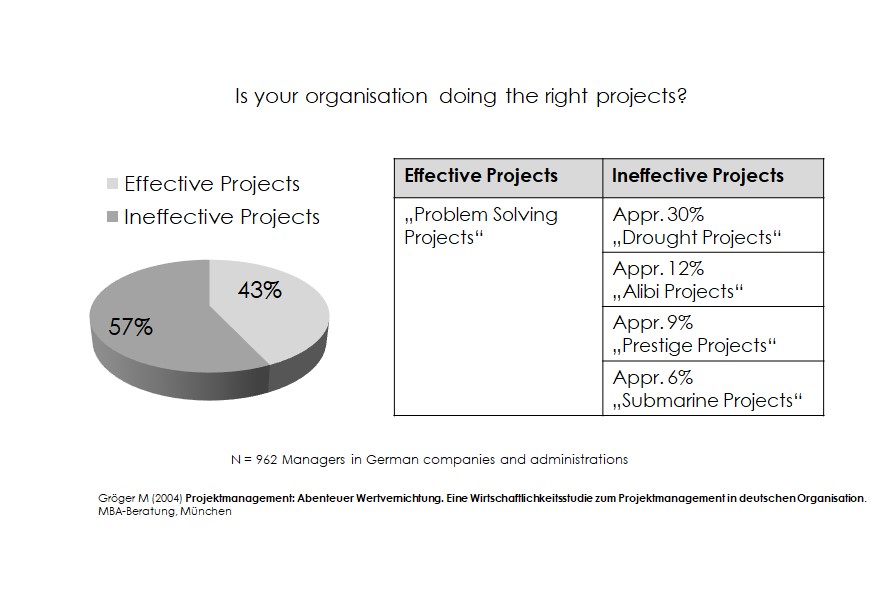
According to an older survey in hich 962 managers have been polled for the value creation of internal projects in German companies (Gröger 2004) the majority of projects have been assessed as being ineffective. Reasons for this rating are insufficient resource allocation ("Drought Projects"), superficial adressing of topics without added value for the company ("Alibi Projects"), mere picking up of trend topics ("Prestige Projects") or singular initiatives without broad support ("Submarine Projects"). A further proportion of projects - according to our assumptions - might be rated as being effective but are just compensating negative effects which have been caused by prior projects.
Nowadays we observe a kind of "project fatigue" and "change depressivity". Said phenomena are usually adressed by appeals for "change management" and "continous improvement". Such appeals regulary miss the point that apathy for change is rooted in two facts which are corroborated by abovementioned survey: too many projects and too little properly designed and selected projects.
From our point of view, the vicious circle of "lifelong change projects" in organisations can be disrupted by two measures:
Firstly, by a strict diet in initiating new change projects. This can be attained by a value-oriented project charter as well as a "triple-decker elevator pitch" (Erne 2019b). Both measures intend to review and elaborate the value of a new project in a more powerful and a more precise manner. As a result, many projects will not be started at all.
Secondly by defininig project goals in a balanced way. For example, if a change project intends to streamline the resource allocation an opposite goal, e.g. als quality goal, should be stated in parallel in order to prevent a single-sided optimisation neglecting unwanted effects (resulting in a follow-up project two years later intending to compensate for the negative outcomes of the preior project).
According to our experince, abovementioned two measures are quite effective for decelerating the vicious circle of continous change projects at least with respect to the "rotational speed".
Literature:
Erne, R. (2019a) Lehrbuch Prozessmanagement. Konstanz, Allensbach University.
Erne, R. (2019b) Lean Project Management: Wie man den Lean-Gedanken im Projektmanagement einsetzen kann. Wiesbaden, Springer Gabler.
Gröger M (2004) Projektmanagement: Abenteuer Wertvernichtung. Eine Wirtschaftlichkeitsstudie zum Projektmanagement in deutschen Organisation. MBA-Beratung, München.